Once a week time is spent trying to find light-bellied brent geese around Lindisfarne. Today there were no geese at Beal but other birds included a stunning male peregrine perched on a post on the shore. There were no geese at Fenham, Smeafield, Ross or Easington Demesne. Finally I found about 90% of the brent that are left on the reserve one grass field next to the shore on Elwick. There were approximately 1000 brent that were accompanied by 450 pink-footed geese and about 40 barnacle geese. Surrounding fields held about 650 curlew most of which were feeding in stubbles. According to the Birds of the Western Palearctic, there no reference of curlews using this habitat but it is a common occurance in and around Lindisfarne.
A large flock (250) greylag were feeding in Lilburn park on the way home. Hopefully the sun will continue to shine.
Friday, 15 February 2013

Thursday, 14 February 2013
Beadnell to Newton 13 Feb
I've no idea really why I spent three hours in yesterday's blizzard walking from Beadnell to Newton and back - but I did. The tide was well out so there was little visible on the shore and the driving snow didn't help. Beadnell Bay had a few Bar-tailed Godwit as well as Oystercatchers and a solitary Ringed Plover.
The Long Nanny area failed to produce any coastal passerines, but there was a small group of Dunlin, a couple of Redshank and a solitary Red-breasted Merganser on the burn. Then further towards Newton a flock of about 35 Golden Plover got up from the field and flew overhead across the dunes. A solitary Kestrel was also patrolling the dunes. As we stopped for sandwiches in the lee of a dune at Newton a Carrion Crow was around with an unusual white throat patch.
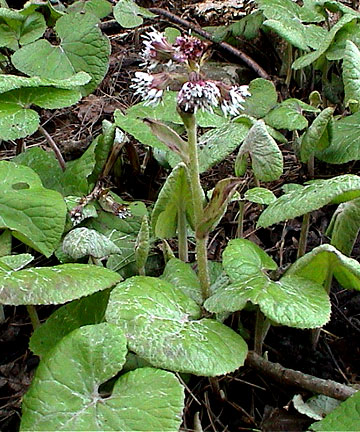
On the seafront at Beadnell there was a good patch of Winter Heliotrope (Petasites fragrans) in flower. This is an uncommon species in Northumberland. N.B. Not my photo!
The Long Nanny area failed to produce any coastal passerines, but there was a small group of Dunlin, a couple of Redshank and a solitary Red-breasted Merganser on the burn. Then further towards Newton a flock of about 35 Golden Plover got up from the field and flew overhead across the dunes. A solitary Kestrel was also patrolling the dunes. As we stopped for sandwiches in the lee of a dune at Newton a Carrion Crow was around with an unusual white throat patch.
On the seafront at Beadnell there was a good patch of Winter Heliotrope (Petasites fragrans) in flower. This is an uncommon species in Northumberland. N.B. Not my photo!
Tuesday, 12 February 2013
The singing has started
Lighter mornings has meant that the start of the dawn chorus; robins, coal tits, song thrushes and house sparrows all have begun to sing in and around Glanton.
Clam conditions on Saturday produced a good mix of waders and ducks using Fenham Flats. A small party of ringed plover still can be found close to the hide at Fenham le Moor. This is unusual as it is normally May when these birds are found on this stretch of mud flat. The calm conditions produced a count of 25 slavonian grebes, 4 long tailed ducks, a female common scoter and a young female scaup. Barnacle geese were present at both Fenham and Ross with reasonable numbers (340) of pink footed geese. A female peregrine and a little egret were located north of Fenham Hill.
Some of the early perennial plants are starting to throw their first leaves. The most obvious species is the lesser celandine in permanent pastures. The lime coloured leathery leaves of the common scurvey-grass is much in evidence in front of the hide at Fenham le Moor.
Away from the coast, the boys and I have had excellent views of barn owls between Chatton and Lilburn and a second bird in the Roseden area on Saturday evening.
Clam conditions on Saturday produced a good mix of waders and ducks using Fenham Flats. A small party of ringed plover still can be found close to the hide at Fenham le Moor. This is unusual as it is normally May when these birds are found on this stretch of mud flat. The calm conditions produced a count of 25 slavonian grebes, 4 long tailed ducks, a female common scoter and a young female scaup. Barnacle geese were present at both Fenham and Ross with reasonable numbers (340) of pink footed geese. A female peregrine and a little egret were located north of Fenham Hill.
Some of the early perennial plants are starting to throw their first leaves. The most obvious species is the lesser celandine in permanent pastures. The lime coloured leathery leaves of the common scurvey-grass is much in evidence in front of the hide at Fenham le Moor.
Away from the coast, the boys and I have had excellent views of barn owls between Chatton and Lilburn and a second bird in the Roseden area on Saturday evening.
Sunday, 10 February 2013
Alnmouth 10th Feb
A very cold windy morning the highlight being a pair of Goosander on river past the Duchess Bridge. Six to 10 Common Scoter were bobbing about on the sea and about 70 swans were in a field on the way to Warkworth. Were they Mute or Whooper, too far away to be certain.
Wednesday, 6 February 2013
Branton Ponds 6th February
Even though the wind was brisk and cold,Branton Ponds still held a good number of birds ,Wigeon were the most numerous with smaller numbers of Teal and Mallard.Also showing well were 3
male Goldeneye as they displayed to any female bird that was watching,a small group of Goosander numbering 12 birds glided by in a tight huddle. Of interest was the 3 Cormorants on one of the islands,one of the birds showed a white head pattern strongly indicative of the continental race "sinensis ".
male Goldeneye as they displayed to any female bird that was watching,a small group of Goosander numbering 12 birds glided by in a tight huddle. Of interest was the 3 Cormorants on one of the islands,one of the birds showed a white head pattern strongly indicative of the continental race "sinensis ".
Monday, 4 February 2013
Spring is here (?!)

My photo was taken last year at a slightly later stage of development - probably April - so you have to imagine the flower spikes short, smaller and much greyer.
Meanwhile the Snowdrops are developing well in Bolton village and up Titlington Lane.
Saturday, 2 February 2013
Alnmouth and Foxton area - a Short Eared Owl has been seen during January hunting by the side of the village golf course and a Barn Owl on the 24th on the top of the hill. At least 150 Redwings and Fieldfares enjoyed feeding on Foxton golf course in areas not covered by snow. They were joined at least once by a Woodcock.
Subscribe to:
Comments (Atom)